Improvements In Surgery for Minimally Invasive Repair
The miraculous cure that surgery can provide for patients historically comes at a cost to the patient in terms of injury to tissues from the incision and from the surgical dissection performed to expose the anatomy needing repair. Surgery has evolved to make surgery easier to tolerate with smaller incisions and more precise tools used to repair the problem with less trauma than before.
Laparoscopic Technique for Abdominal Surgery
The original surgical technique for abdominal surgery and abdominal hernia problems referred to as MIS was “laparoscopic surgery”. The art of
laparoscopic abdominal surgery began in the late 1980s. It involved incisions less than 0.5 inches and visualization of the surgical problem via cameras attached to telescopes that fit through these small incisions. The surgical instruments used for the surgery were also designed to be long and with a low profile allowing them to be held with handles outside the patient controlling the movement of scissors or grasping devices inside the patient's abdomen. The surgeon's assistant would hold the camera and the surgeon performed the surgery holding an instrument in his or her right and left hands. The surgeon and the surgical team would be performing and watching the surgical procedure on a video monitor where the surgical procedure was focused. The laparoscopic revolution has accelerated with newer technology over time.
Robotic Repair for Minimally Invasive Surgery
Just as cameras and lighting and engineering of instruments improved over the years it has led to the current MIS state of the art referred to as “Robotic Surgery”.
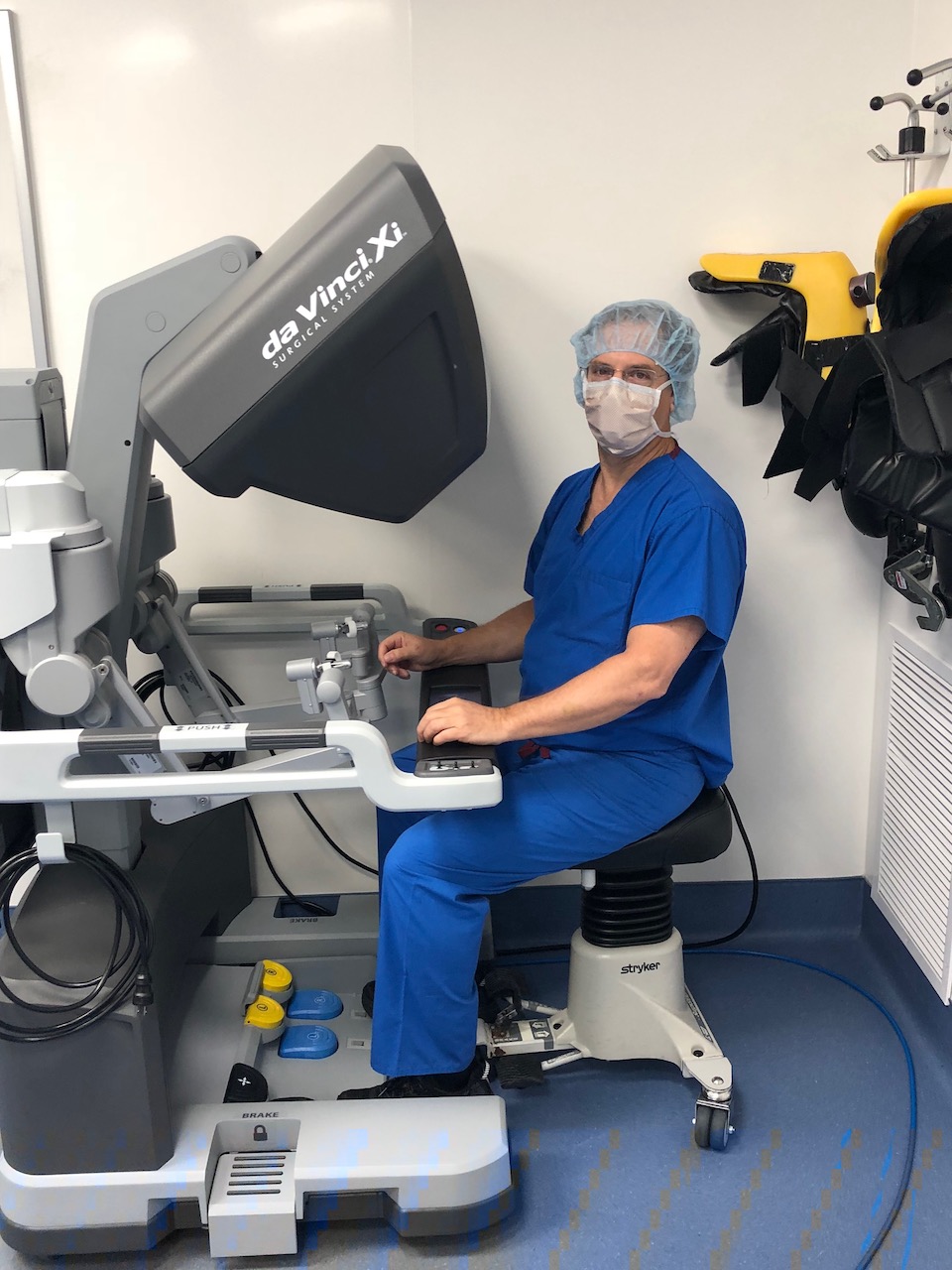
Robotic surgery utilized the finest lighting and optics and resolution of our time. The instruments are so precise that they rotate and articulate inside the patient with accuracy that rivals the human hand. The camera and instruments are attached to a “
robotic arm system” - thus the word “Robotic”. After the surgeon safely inserts the camera and instruments into the patient, the surgeon then sits down in a virtual reality like console immersed in a 3-dimensional high resolution view inside of the abdomen. The surgeon's finger, hand, and foot movements are translated into electrical signals that control and move the camera and instruments in the patient’s abdomen.
Minimally Invasive Surgery: Smaller Incisions, More Precise Visualization
The robotic surgical advantage is its minimally invasive impact in surgical techniques via smaller incisions and more precise visualization and dissection of the surgical area. This often leads to a surgical outcome that is more reliably excellent and with less pain. The recovery from MIS robotic hernia repair is expected to be less painful and allows for a more rapid return to life's activities and demands. The Robotic platform requires a lot of practice before a surgeon becomes proficient. There is a simulator that is used to enhance this growth in skills and expertise in this technique.
Does Minimally Invasive Hernia Surgery Mean Less Pain?
Every patient is different and every hernia is unique in its appearance and severity of pathology. These variables are what correlate with the challenges that surgeons face in hernia repair. Mastery of robotic techniques typically yields a surgical outcome with less pain and a shorter recovery. There are always exceptions based on the patient and hernia's unique characteristics. Some MIS laparoscopic or Robotic procedures can still be painful because of this variability.
Recovery After Minimally Invasive Hernia Surgery
The smaller incisions and more precise tools of modern minimally invasive surgery often lead to a shorter and easier recovery from hernia repair. Some techniques that are done “open” with a larger incision can also be less painful and have short recoveries associated with them. Any surgeon who continues to gain experience and works to improve technique can be performing open surgery with minimal pain and short recoveries.
When Minimally Invasive Surgery May Not Be the Best Option
Minimally invasive laparoscopic and robotic surgery is based on small incisions to enable surgery from an approach inside of the abdominal cavity. There are some hernia repairs that benefit from an “anterior” or “open” approach and therefore the robotic option is not an option. The anterior approach is oftentimes favored for patients that want an inguinal hernia repair without mesh.
The
Shouldice and
Desarda inguinal repair techniques are anterior open approaches and do not involve the use of laparoscopy or robotic tools. Another example is a patient who had a hernia repair performed robotically and developed a
recurrence of the hernia. The open anterior approach is typically selected as a safer way that avoids operating in tissue planes that may have significant scarring.
Choosing the Right Hernia Surgeon Matters
Not every surgeon who performs hernia repair specializes in the complexity of hernias, recurrence, chronic pain, or advanced minimally invasive techniques. When evaluating your options, it’s important to look for a surgeon with extensive hernia-specific experience, a deep understanding of both robotic and open repair techniques, and the ability to tailor the approach to your unique condition rather than relying on a one-size-fits-all solution.
At
Center for Hernia Repair,
Dr. Jonathan Yunis specializes exclusively in hernia surgery, including
minimally invasive robotic repair, recurrent hernias,
complex abdominal wall reconstruction, and
non-mesh tissue-based repairs such as Shouldice and Desarda techniques. Patients travel from across the United States and internationally to seek expert evaluation and personalized treatment recommendations designed around long-term outcomes, recovery, and quality of life.
Whether you are exploring minimally invasive surgery for the first time, dealing with a recurrent hernia, or searching for options after
mesh-related complications, choosing a surgeon with focused expertise can make a meaningful difference in both your surgical experience and recovery.
FAQs About Minimally Invasive Hernia Surgery
Is minimally invasive hernia surgery safer than open surgery?
Yes and no. It depends on the patient, surgeon and hernia. Many complicated hernia cases that have significant intraabdominal adhesions are often more safely performed with the
DaVinci robot because of its enhanced optical resolution and precise instruments. This allows for a lower risk of injury to tissue and specifically lower risk of “enterotomy” or opening of the intestine.
How long does minimally invasive hernia surgery take?
With experience and expertise in the MIS techniques, most surgeries can be performed in a similar or shorter period of time than conventional open techniques.
What is the recovery time for laparoscopic hernia repair?
It varies based on the type of hernia being repaired. For most groin hernia repairs, recovery is often less than a few weeks. For some complicated ventral hernia repairs , the recovery can be considered to be 1-2 months to feel fully recovered.
Can all hernias be repaired minimally invasively?
Most hernias can be performed minimally invasively. Some will require an open anterior approach which eliminates the use of the laparoscopic or robotic tools.
Is robotic hernia surgery better than laparoscopic?
Yes it is better because of the enhanced technology allowing for better visualization and better precision in dissection and exposure of the hernia.
What are the risks of minimally invasive hernia surgery?
The risks are based on the type of hernia repair being performed. Assuming the surgeon has gained expertise with the robotic or laparoscopic technique, there are no increased risks of any particular complication.